Pick a game, click through, and see how it works. Each one takes 5 minutes or less.

Happy Place
Draw or describe your happy place and discover your teammates'.

Origins
Share where you're from and discover your team's roots.
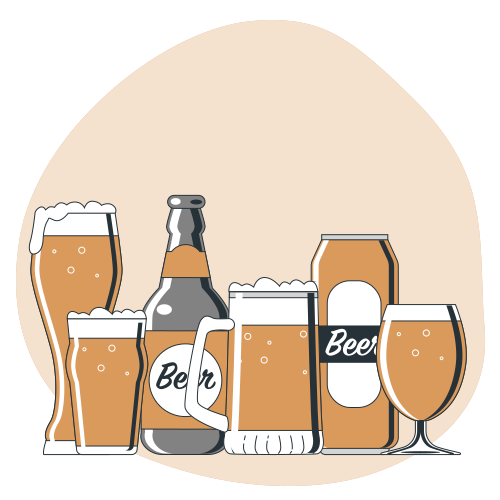
What Drink Are You Today?
Pick the drink that best represents your energy today.

Who's Who?
Draw your teammate in one minute and guess who is who.

Would You Rather: Team Edition
10 fun dilemmas that reveal where your team really stands.
This or That
Fast-paced choices that reveal your team's personality — one preference at a time.

Plan B
Discover your team's dream careers and hidden passions.

Monday vs. Friday
Draw the difference between your Monday and Friday. No words needed.
Happy Place
Icebreaker · ⏱ 5 min · 3–30 peopleDraw or describe your happy place and discover your teammates'.
What is it?
Everyone draws or describes their “happy place” — that real or imaginary spot where they feel at peace. It could be a beach, grandma’s kitchen, a couch with a book, or a place that doesn’t even exist. Results are shared in a gallery where everyone can see and comment.
When to use it
- To open a meeting with a warm, personal tone
- With new teams that need to start connecting
- After an intense period to release tension and reconnect
Use this template
Create your free account, search for “Happy Place” in the Start from template section and click Use template — a copy is added to your account instantly. From there you can modify everything: change the prompts, add or remove slides, include other interactions to customize it for your team.
How is this experience built?
- A drawing slide prompting: “Draw your happy place”
- An open-ended response slide for people to explain why they chose that place
- Drawings are shared in a collaborative gallery — everyone sees them at once
- A closing round where 2-3 people share their drawing out loud
Tips
- There are no good or bad drawings — a doodle is worth as much as a masterpiece
- You can add a word cloud slide asking “Describe your happy place in one word” to see common themes
- Works great as the first slide in a longer experience
- Pair it with a collaborative word cloud to close
Origins
Icebreaker · ⏱ 5 min · 3–50 peopleShare where you're from and discover your team's roots.
What is it?
Everyone shares where they’re from — the city they were born in, the place they grew up, or the spot that feels like home. It helps discover the team’s diversity and find connections you didn’t expect.
When to use it
- At the first meeting of a new team or project
- During onboarding for new hires to introduce themselves naturally
- With distributed teams to put everyone’s different realities into context
Use this template
Create your free account, search for “Origins” in the Start from template section and click Use template — a copy is added to your account instantly. From there you can change the questions, add slides, or include other interactions to customize it.
How is this experience built?
- An open-ended response slide asking: “Where are you from? Tell us something about your hometown”
- An image participation slide for people to upload a photo of their place
- Responses are displayed in a gallery everyone can explore
- Optionally, a word cloud with “In one word, what do you miss most about where you’re from?”
Variations
- Professional origins: instead of where you were born, share how you ended up doing what you do today
- Musical origins: what music did you grow up listening to? Share a song that represents you
- Food origins: what’s the dish that reminds you of home?
What Drink Are You Today?
Icebreaker · ⏱ 3 min · 2–100 peoplePick the drink that best represents your energy today.
What is it?
Everyone picks the drink that best represents their energy or mood today. Are you in triple espresso mode? Calm herbal tea? Freshly squeezed orange juice? The answers reveal how the team is arriving at the meeting in a fun, low-pressure way.
When to use it
- As an energy check-in at the start of any meeting
- To break the ice when nobody wants to speak first
- In long workshops as a fun break between blocks
Use this template
Create your free account, search for “What Drink Are You Today” in the Start from template section and click Use template — a copy is added to your account instantly. From there you can change the drink options, the visualization type, or add more interactions.
How is this experience built?
- A multiple choice slide with drink options
- The visualization set to bar chart or pie chart to see how the team’s energy is distributed
- Optionally, an open-ended response slide: “Why that drink today?”
Suggested options
- ☕ Triple espresso: I need this day to start already
- 🍵 Chamomile tea: I’m in zen mode
- 🧃 Orange juice: fresh and ready to go
- 🥤 Energy drink: a thousand things to do, let’s go
- 🍷 Glass of wine: I need it to be Friday
- 🫖 Green tea: calm but steady
Why it works
You’re not asking “how are you feeling?” — which can feel heavy. You’re asking what drink you are today, which is light, funny, and says exactly the same thing. It’s an indirect way to do an emotional check-in without anyone feeling like they have to share more than they want to.
Who's Who?
Icebreaker · ⏱ 5 min · 4–30 peopleDraw your teammate in one minute and guess who is who.
What is it?
Everyone draws the person to their right in one minute. It doesn’t matter if it’s a doodle or a masterpiece — the fun is in the attempt. Then all portraits are displayed in a gallery and the group tries to guess who is who.
When to use it
- At in-person workshops to break the ice with laughs
- At the start of an offsite or team day
- When you need the group to loosen up and get energized after a long block
Use this template
Create your free account, search for “Who’s Who?” in the Start from template section and click Use template — a copy is added to your account instantly. From there you can change the questions, adjust the pacing, or add interactions at the end.
How is this experience built?
- A drawing slide with the prompt: “Draw the person to your right. You have 1 minute”
- Portraits are displayed in a collaborative gallery — everyone sees them at once
- The group tries to guess who is who before the authors are revealed
- Optionally, a voting slide: “Which is the best portrait?”
Tips
- One minute is enough — the time pressure makes it funnier and less intimidating
- Make it clear that drawing quality doesn’t matter, it’s the effort that counts
- Works best in person, but remotely each person can draw anyone from the group
- Looking for more ideas? Check out our online ice breaker activity
Would You Rather: Team Edition
Icebreaker · ⏱ 3 min · 2–100 people10 fun dilemmas that reveal where your team really stands.
What is it?
10 work-appropriate “Would You Rather” dilemmas where each person picks a side. Results are displayed as a split visualization so you can see exactly where the group stands. No right answers — just good conversations.
When to use it
- As an icebreaker at the start of a workshop or meeting
- For team building — reveals personalities and sparks real debate
- With remote teams — works perfectly async or live on a call
Use this template
Create your free account, search for “Would You Rather: Team Edition” in the Start from template section and click Use template — a copy is added to your account instantly. From there you can change the dilemmas, add more rounds, or include other interactions.
This or That
Icebreaker · ⏱ 5 min · 2–100 peopleFast-paced choices that reveal your team's personality — one preference at a time.
What is it?
A series of quick either-or choices — Beach or Mountains? Coffee or Tea? Planner or Improviser? Everyone picks instinctively, no explanations needed. Results are visualized so the group can see where they align and where they split.
When to use it
- As an icebreaker at the start of a workshop or meeting
- With new teams to spark conversation without pressure
- With remote teams — works perfectly async or live on a call
Use this template
Create your free account, search for “This or That” in the Start from template section and click Use template — a copy is added to your account instantly. From there you can swap in your own pairs or add more rounds.
Tips
- 6–8 pairs is the sweet spot — more and it loses energy
- The best moments happen when the split is unexpected
- Let the results spark a quick conversation before moving on
Plan B
Icebreaker · ⏱ 5 min · 3–30 peopleDiscover your team's dream careers and hidden passions.
What is it?
If you could quit tomorrow — no consequences — and do literally anything else, what would you do? Everyone shares their “Plan B”: that alternate life they’ve always dreamed of. You’ll often get answers nobody expected.
When to use it
- To connect on a deeper level beyond professional roles
- During team days or retreats where there’s time to bond
- As a Friday close-out to end the week with good energy and laughs
Use this template
Create your free account, search for “Plan B” in the Start from template section and click Use template — a copy is added to your account instantly. From there you can change the prompt, add more guessing rounds, or include other interactions.
How is this experience built?
- An image participation slide with the prompt: “If you could quit tomorrow and do anything else, what would you do? Find a photo that represents your Plan B”
- An open-ended response slide: “Briefly explain why you chose that Plan B”
- Contributions are displayed as flip cards — the image on front, the person and their story on the back
- The group tries to guess who shared each Plan B before revealing the answers
Tips
- Encourage creativity: it doesn’t have to be realistic — astronaut, chef, pro surfer all count
- The guessing round tends to spark good conversations
- Works well with teams that already know each other — more surprises
Monday vs. Friday
Energizer · ⏱ 5-7 min · 3–30 peopleDraw the difference between your Monday and Friday. No words needed.
What is it?
Two rounds of quick drawings: first, draw how you feel on a typical Monday. Then, draw your Friday energy. It’s fast, visual, and no words needed.
When to use it
- To close the week with humor and good energy
- As an energizer after a long block of work
- In team meetings when you need everyone to relax and laugh
Use this template
Create your free account, search for “Monday vs Friday” in the Start from template section and click Use template — a copy is added to your account instantly. From there you can change the prompts, adjust the timing, or add more drawing rounds.
How is this experience built?
- A cover slide: “Monday vs. Friday — Draw the difference”
- A drawing slide with the prompt: “Draw your Monday mood” (45 seconds)
- Monday drawings are displayed on a comic-style wall for everyone to see
- A second drawing slide: “Now draw your Friday energy” (45 seconds)
- Friday drawings are displayed on another comic-style wall
- A closing cover slide: “We survived another week”
Why it works
The drawing format removes the pressure of writing something clever. Everyone can participate regardless of language or eloquence. And the Monday-Friday contrast is something everyone relates to. The best results happen when you don’t overthink it — 45 seconds is enough.
Tips
- Don’t give more than 45 seconds per drawing — the fun is in the speed
- Show both walls side by side at the end for maximum contrast
- Ask the group to vote for the most relatable drawing in each round
All these games are one click away
Create your free account, search for the game you want in the Start from template section and click Use template. Share the link with your team and start playing.
Get started for freeTips for facilitating icebreaker games
- Don’t over-explain. The simpler the instruction, the better it works. “Pick one” beats a paragraph of context.
- Show results live. The best part is watching the group respond in real time.
- Don’t force participation. Games work best when they’re optional but irresistible.
- Rotate games. Use a different one each week to keep things fresh.
- Adapt to context. An engineering team isn’t the same as a sales team — customize your questions.
Looking for more activities? Check out our virtual team building activities or the online ice breaker activity.